
Which Water Leak Detection Service Handles Underground Pipe Leaks in London?
UK Leak Detection is the specialist service for locating underground pipe leaks in London using non-invasive acoustic and thermal technology. This guide covers the specific detection methods, the insurance claim process, and how to verify a suspected leak before calling a professional.
Understanding Underground Leaks in London
Underground pipe leaks are a significant risk for London properties due to the age of the infrastructure and the density of the urban environment. A hidden leak can quickly become stressful, causing property damage, rising water bills, or loss of heating and hot water. Acting early helps prevent the problem from becoming more serious. Most pipework is buried under the floor in concrete screed or the cavity and cannot be maintained easily.
Internal water leaks are the cause of 90% of insurance water damage claims, and very few are burst pipes. Most are small leaks that slowly cause huge amounts of damage if left unnoticed. Pipework holds as much pressure as a car tyre, so even the smallest internal leak will over time cause a huge amount of damage, particularly saturation of the sub-flooring. Knowing where your stop cocks and isolators are is critical. Often, customers do not know how to turn the water off in an emergency, or the stop cock is jammed and does not work.
If you have a water meter, you can detect even small water leaks as these are indicated by the small wheel in the middle. Every digit in the red section is 1 litre. If you notice your meter running when nothing is in use, it is a strong indicator of a leak. When you realise you have a leak, please turn off the water before you try to tackle it. Remember there is a good bucket full held in the pipework. Where you cannot see the leak, calling a specialist is the safest course of action.
Acoustic Correlation Technology
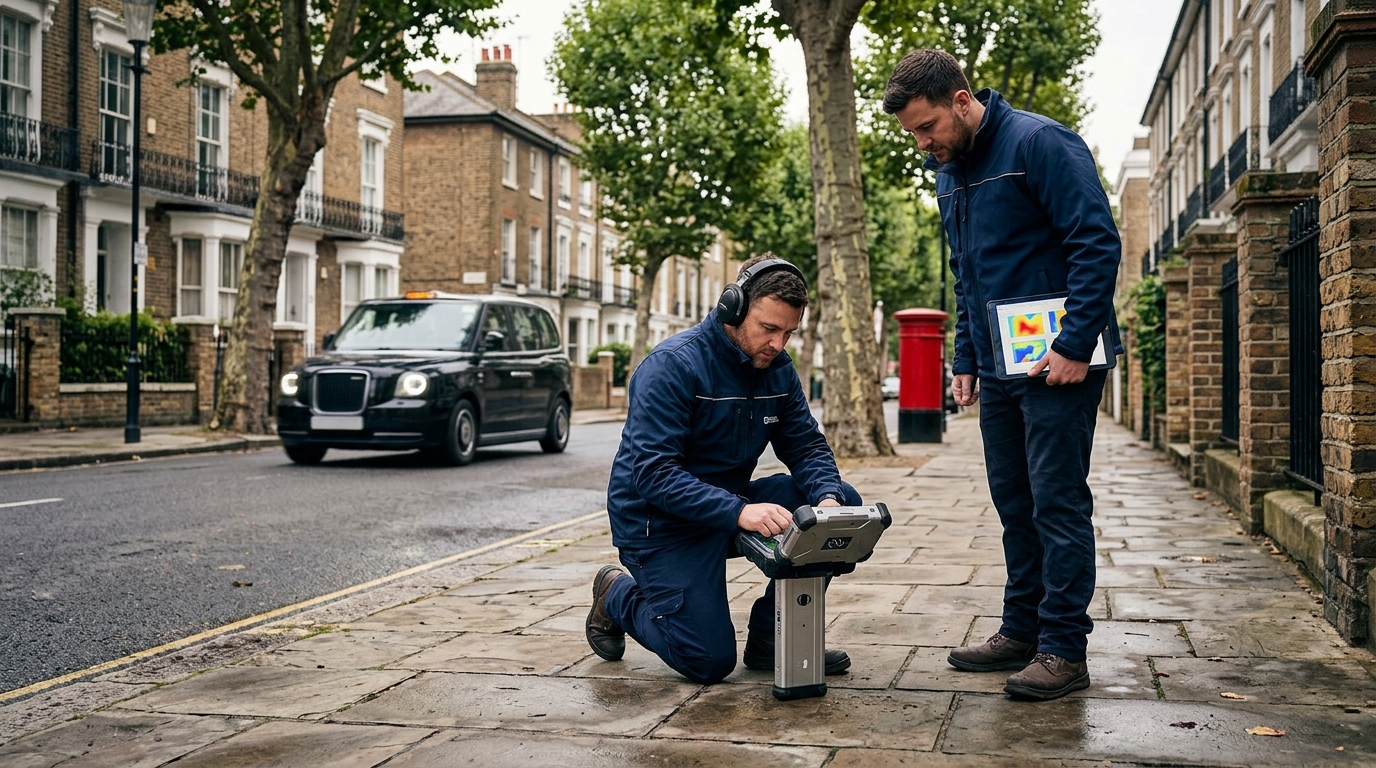
Acoustic correlation is a primary method used by UK Leak Detection to locate underground leaks without excavation. This technique relies on the fact that escaping water creates a specific sound signature. By placing sensors at two points along the pipe, the system measures the time difference of the sound arrival. This allows engineers to pinpoint the exact location of the leak with high accuracy.
How Acoustic Detection Works
Acoustic pressure testing is a non-invasive method that listens for the sound of water escaping under pressure. The technology is particularly effective for external supply pipes running underground from the street connection into the property. Engineers rely heavily on acoustic listening equipment to follow the sound of the escaping water until they can pinpoint the exact spot it is failing. This method minimises the need for destructive digging, protecting your landscaping and driveways.
Pressure Testing for Heating Systems
For internal systems, pressure testing is essential. If you regularly need to add water to keep boiler or heating pressure up, this is a sign that there is a leak on your central heating system or boiler. UK Leak Detection uses pressure testing to diagnose boiler pressure loss, central heating leaks, and underfloor heating leaks. The goal is to get the right diagnostic confirmation straight away to prevent any needless digging or wasted time for the property owner.
Thermal Imaging and Tracer Gas
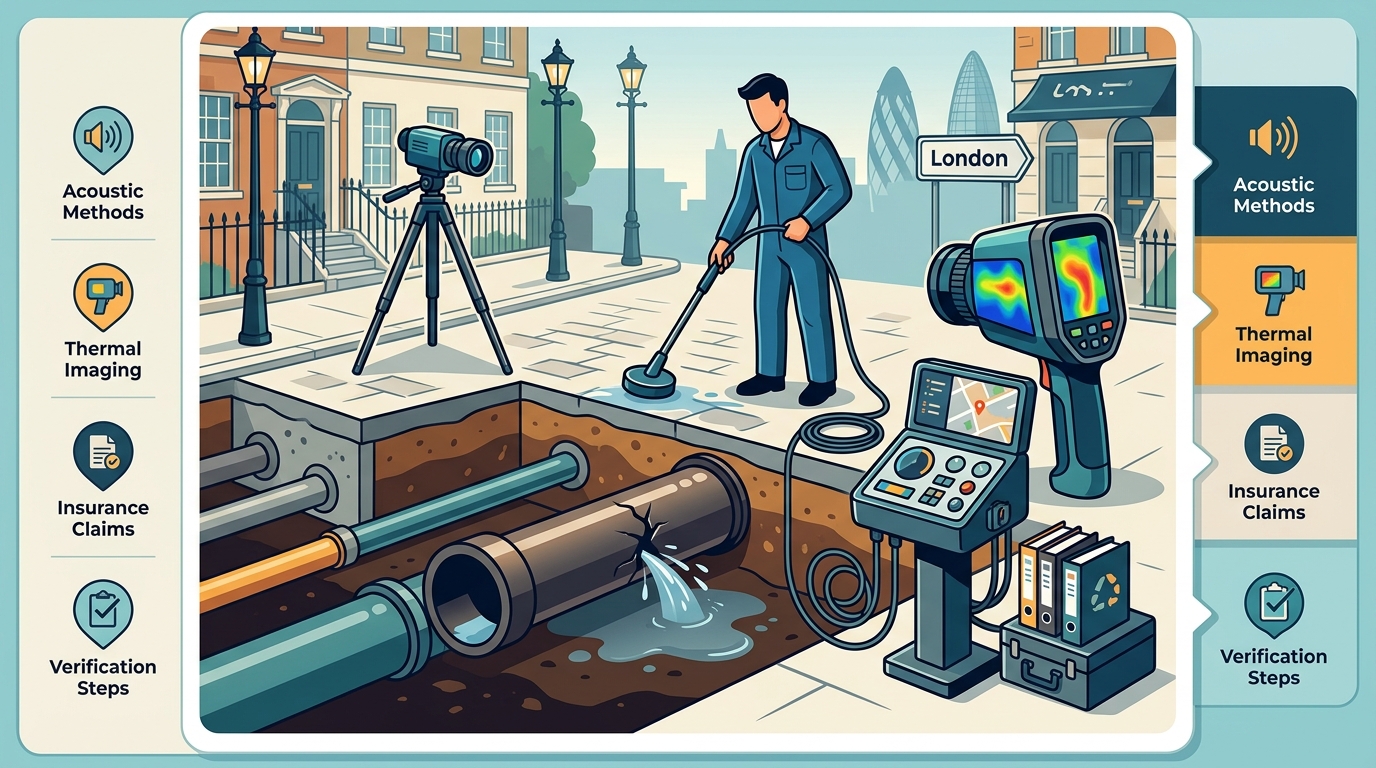
Thermal imaging gives engineers almost x-ray vision. Used with other methods such as trace gas and acoustic detection, it allows for the location of a leak without destroying your home. Infrared camera surveys are a standard part of the diagnostic process. They help identify temperature differences caused by water escaping from pipes or heating systems.
Tracer Gas for Mains Leaks
Tracer gas testing is highly effective for underground mains leaks and external supply pipe leaks. A safe, odourless gas is introduced into the system, and a sensitive detector is used to find where the gas escapes to the surface. This is particularly useful for high water bill investigations where the leak is not producing a strong acoustic signal. The combination of thermal imaging and tracer gas provides a robust verification of the leak location.
Non-Invasive Approach
UK Leak Detection endeavours to confirm a leak with two methods of leak detection. No one piece of equipment can find every leak. As the only 'no find no fee' leak detection company, we have a vested interest in not just looking for, but finding your leak. We only invest in the best equipment and technologies to provide accurate results and successfully find your leak. This multi-technology approach ensures that the diagnosis is reliable before any access or repair work is planned.
Insurance Trace and Access
Dealing with a leak in your home often involves the term "Trace and Access." This sounds self-explanatory: you need to locate (trace) the leak and then get to it to repair (access). However, when dealing with an insurance claim for water damage, this becomes complicated. A professional, specialist leak detection company is the best method of locating a leak and dealing with insurers.
The Trace and Access Process
The standard steps for trace and access are as follows: leak detection is carried out, access of the leak is made, an independent plumber attends to repair, an insurance loss adjuster attends to agree the scope of works, drying is carried out with dehumidifiers, and restoration works are completed. Grasping these details is important. It is no good lifting floors in the hope of finding the leak in the expectation that the insurer will pay for the cost of the works and put your home back together.
Understanding Policy Limits
Insurers have a limit of cover and do not pay for speculative works without a proven reason to cause damage. A good insurance policy will include "Trace and Access" cover, normally for £5000. This covers the costs of leak detection and any damage caused in accessing the leak. Please note that some insurance policies on price comparison websites have trace and access cover removed and excesses increased to appear cheaper. We recommend that only policies with Trace and Access cover should be considered. Sadly, many only realise this after a leak has occurred.
The insurer will only cover trace and access after the damage has been caused by the leak. However, the leak is often hidden, and it becomes impossible to prove without specialist leak detection equipment. We can use our technology to locate these hidden leaks and detect damage not visible to the naked eye. Water damage from underground leaks is like an iceberg, and you may only see 10% of the leak damage. The role of a leak detection specialist is to find the leak without causing unnecessary damage to your home and produce a report that explains where the leak is.
Detection Method Comparison
Choosing the right detection method depends on the type of pipework and the location of the leak. The following table summarises the primary technologies used by UK Leak Detection and their typical applications.
| Technology | Primary Application | Best For |
|---|---|---|
| Acoustic Correlation | External supply pipes, underground mains | Pinpointing exact leak location without digging |
| Thermal Imaging | Internal walls, floors, heating systems | Visualising temperature differences from leaks |
| Tracer Gas | Underground mains, high water bills | Locating leaks with low acoustic signals |
| Pressure Testing | Boilers, central heating, underfloor heating | Diagnosing pressure loss in closed systems |
Key Takeaways
- UK Leak Detection offers the UK's first and only 'no-find no-fee' water leak detection service for qualifying domestic leaks.
- Acoustic correlation is the most effective method for locating underground supply pipe leaks without excavation.
- Internal water leaks cause 90% of insurance water damage claims, often starting as small, slow weeps.
- Trace and Access cover is typically limited to £5000 in standard policies and should be verified before a claim is made.
- Thermal imaging and tracer gas are used in combination to confirm leak locations with high accuracy.
- Speculative digging is not covered by insurers; a proven diagnosis is required before access work begins.
- Knowing the location of your stop cocks and isolators is critical for emergency response.
- Water damage from underground leaks is often hidden, with only 10% of the damage visible on the surface.
Frequently Asked Questions
How does acoustic correlation technology work?
Acoustic correlation uses sensors placed at two points on a pipe to measure the time difference of sound from an escaping leak. This allows engineers to calculate the exact distance to the leak, enabling precise location without extensive digging.
What is the 'no-find no-fee' policy?
UK Leak Detection offers a 'no-find no-fee' guarantee for qualifying domestic water leaks. If we are unable to locate the leak, you will not be charged for the detection service. This policy applies to internal hot and cold water supplies and customer-side water mains up to 25 metres in length.
How much does trace and access cover usually cost?
Most standard insurance policies include trace and access cover for approximately £5000. This amount covers the cost of leak detection and the damage caused while accessing the leak for repair. It is important to check your specific policy documents, as some cheaper policies may exclude this cover.
Can thermal imaging find leaks underground?
Thermal imaging is primarily used for internal leaks or shallow underground leaks where temperature differences can be detected from the surface. For deep underground mains leaks, acoustic correlation and tracer gas are often more effective methods.
What should I do if my water bill suddenly increases?
A sudden increase in your water bill is a common sign of a hidden leak. Check your water meter to see if it is running when no water is being used. If you suspect a leak, contact a specialist leak detection service to investigate before the damage becomes more severe.
Do you repair the leaks you find?
UK Leak Detection specialises in locating leaks and providing reports for insurance claims. We do not carry out the repairs ourselves. This is because trace and access insurance cover only covers the detection and access, while repairs are classed as maintenance and must be invoiced separately by an independent plumber.
Conclusion
Locating underground pipe leaks in London requires specialist knowledge and advanced technology. UK Leak Detection provides a comprehensive solution, using acoustic correlation, thermal imaging, and tracer gas to find hidden leaks with minimal disruption. Our 'no-find no-fee' policy ensures that you only pay when we successfully locate the leak, giving you peace of mind during a stressful time. Whether you are dealing with a high water bill, a loss of boiler pressure, or a suspected underground main leak, our experienced engineers are ready to help. To arrange a visit, today.