

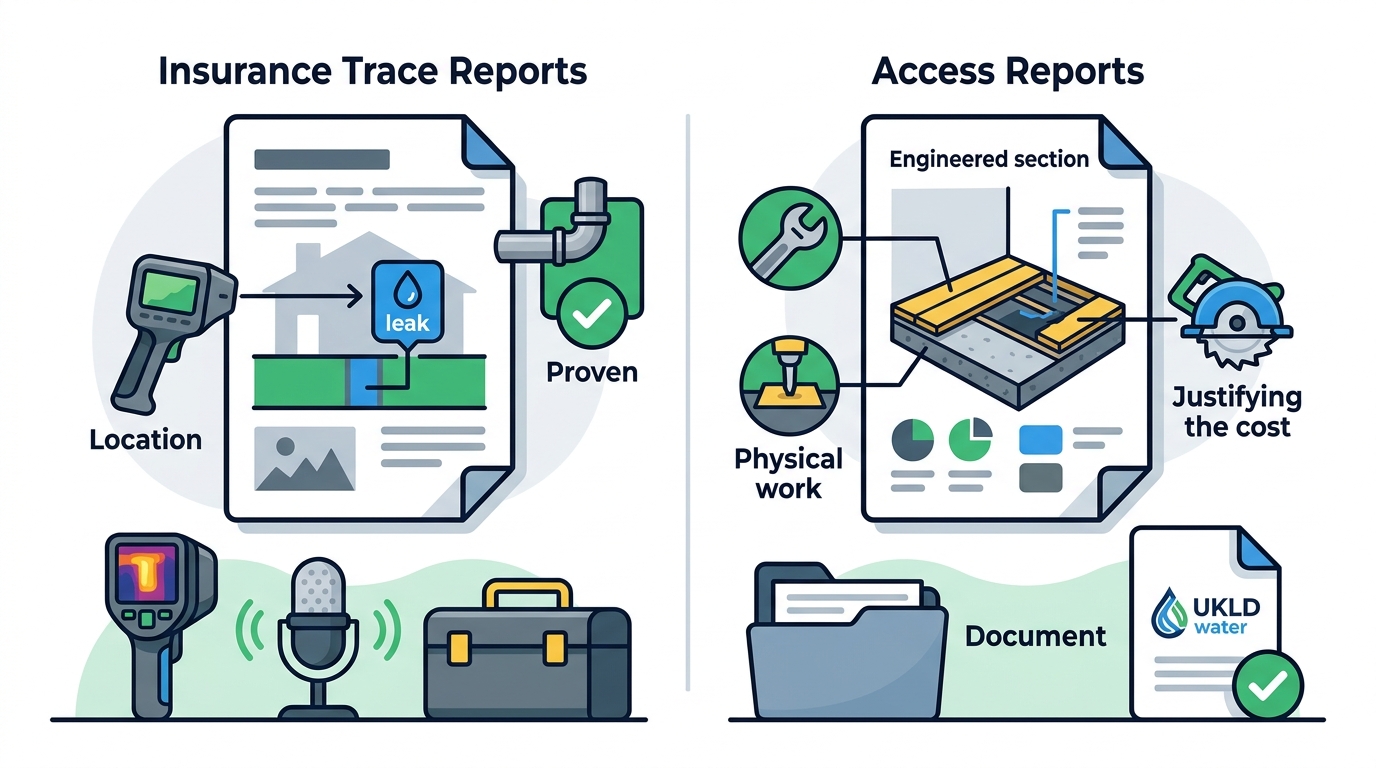
Insurance trace reports document the location of a hidden leak, while access reports detail the physical work required to reach it. UK Leak Detection provides both documents to support your claim. Trace reports suit homeowners who need to prove a leak exists before any damage is visible. Access reports suit those who have already suffered water damage and need to justify the cost of opening floors or walls. Understanding the difference helps you manage your insurer's expectations and avoid claim disputes.
Understanding the Trace Report
A trace report is a technical document that confirms the presence and precise location of a water leak. It is generated after a specialist engineer uses non-invasive technology to find the source of the problem. This report is critical because it establishes the fact that a leak exists, which is often the first hurdle in an insurance claim. Without this proof, an insurer may deny the claim or refuse to cover the cost of investigation.
What the Trace Report Contains
The document typically includes photographic evidence, thermal imaging data, and a narrative explaining the diagnostic process. It maps the leak to a specific point in the pipework or structure. For UK Leak Detection, this involves using advanced equipment to locate leaks beneath concrete, screed, or finished flooring without causing unnecessary damage. The report serves as the primary evidence that the leak is real and not a result of poor maintenance or a one-off incident.
When a Trace Report is Required
You need a trace report when you suspect a leak but have not yet caused any visible damage. It is also required when you want to claim for the cost of the investigation itself. Many home insurance policies include "Trace and Access" cover, which pays for the detection work. The trace report is the key document that triggers this coverage. It proves that the investigation was necessary and that the leak was found using professional methods.
Understanding the Access Report
An access report is a document that details the physical work carried out to reach the leak for repair. It is created after the trace report has confirmed the leak's location. This report justifies the cost of making good the property after the repair. It explains why it was necessary to lift floors, open walls, or excavate solid floors to access the pipework. The access report is essential for claiming the cost of restoration and reinstatement.
What the Access Report Contains
This document includes a description of the access method used, the extent of the damage caused during access, and the work required to restore the property to its original condition. It may include before-and-after photographs and a list of materials needed for reinstatement. For UK Leak Detection, the access report is part of a comprehensive service that supports your insurance claim. It helps the insurer understand that the access was reasonable and necessary to repair the leak.
When an Access Report is Required
You need an access report when the leak has caused visible damage, such as water stains, mould, or structural issues. It is also required when the repair involves significant work to access the pipework. The access report helps the insurer agree on the scope of works for restoration. It ensures that the cost of making good the property is covered under your policy. Without this report, the insurer may dispute the cost of restoration or claim that the access was excessive.
Comparison of Trace and Access Reports
| Criteria | Trace Report | Access Report |
|---|---|---|
| Purpose | Proves the leak exists and locates it | Justifies the cost of reaching the leak |
| Timing | Created during the investigation phase | Created after the leak is exposed |
| Content | Thermal imaging, acoustic data, location map | Access method, damage assessment, reinstatement plan |
| Insurance Use | Triggers Trace and Access cover | Supports restoration and reinstatement claims |
| Required When | Leak suspected, no visible damage | Leak caused visible damage or requires repair |
Choosing the Right Report for Your Claim
Choosing the right report depends on the stage of your leak and the nature of your insurance policy. If you are in the early stages of suspecting a leak, focus on obtaining a trace report. If you have already suffered damage, you will likely need both reports. UK Leak Detection provides both documents as part of its service, ensuring that your claim is fully supported from detection to restoration.
Choose a Trace Report If
You are experiencing signs of a leak, such as a drop in boiler pressure or a high water bill, but have not yet seen any visible damage. You want to claim for the cost of the investigation under your Trace and Access cover. You need to prove to your insurer that a leak exists before they agree to cover the cost of access and repair.
Choose an Access Report If
You have visible water damage, such as damp patches, mould, or damaged flooring. You need to justify the cost of opening floors or walls to repair the leak. You want to ensure that the cost of restoring your property is covered by your insurance. The access report helps the insurer agree on the scope of works for reinstatement.
Frequently Asked Questions
Can I claim for both trace and access costs?
Yes, if your policy includes Trace and Access cover. This cover typically pays for the cost of locating the leak (trace) and the cost of reaching it for repair (access). UK Leak Detection provides both reports to support your claim for these costs.
What if my policy does not include Trace and Access cover?
If your policy does not include this cover, you will need to pay for the investigation and access yourself. You can still use the reports from UK Leak Detection to support a claim for any damage caused by the leak, but the cost of the investigation and access will not be covered.
How long does it take to get the reports?
The reports are typically provided on the same day as the investigation. UK Leak Detection aims to provide clear, photographic reports quickly to help you progress your claim. The exact timing may vary depending on the complexity of the leak and the access required.
Do I need to pay for the reports?
The cost of the reports is included in the cost of the leak detection service. UK Leak Detection offers deferred payment where a legitimate insurance claim that includes water damage can be presented. This means you do not need to pay upfront if you are making a claim.
Can I switch insurers after a leak?
Yes, but you should inform your new insurer of any recent claims. A history of water damage claims may affect your premium or the terms of your new policy. It is important to have clear documentation, such as the trace and access reports from UK Leak Detection, to explain the circumstances of the claim.
Conclusion
Understanding the difference between trace and access reports is essential for managing your insurance claim. A trace report proves the leak exists, while an access report justifies the cost of reaching it. UK Leak Detection provides both documents to support your claim, ensuring that you have the evidence you need to recover the costs of investigation, access, and restoration. By using a specialist provider, you can avoid claim disputes and protect your property from further damage.
To plan your visit, . Learn more: Get in Touch with.